By Tyler Russell
At first glance, Anthony Raibick, 31, doesn’t fit the traditional mold of a three-company CEO.
That’s what echoed throughout his mind, since he was a child at least.
Growing up in East Hanover, New Jersey, just short of 25 miles from New York City, Raibick was the kid who couldn’t sit still, he was always bouncing around and seeking a new thrill.

“He had so much built-up energy,” his mother, Laura Raibick, recalled. “It was constant.”
That energy transitioned with Raibick to the classroom, where in pre-kindergarten, one teacher didn’t mince words, blatantly telling Laura that her son was a “problem child.”
“I didn’t know at the time that he had ADHD, but hearing that my first and, at the time, only kid was a problem child, that really hurt,” Laura said. “Looking back on it, honestly, I would just say that I was confused.”
“I never wanted and still don’t want to be the ‘oh, it’s not my kid’ kind of parent, but Anthony never hurt a fly, argued with his classmates, caused chaos, none of that,” Laura said. “You could tell that he had a lot of energy, but a lot of kids did, so I was very hurt by that comment. I was, I guess just very caught off guard.”
Laura and Anthony weren’t fully aware yet, but he was living with Attention-deficit/hyperactivity disorder, also known as ADHD. ADHD is a brain-based condition that makes it extremely challenging, depending on the severity, to complete simple tasks, focus, and do what “normal” people would consider easy.
Due to this, even simple classroom tasks felt overwhelming. Sitting through lessons, completing assignments, and following routines were daily battles, while on the other end, Anthony’s peers adapted to structure.
Anthony unintentionally pushed against the structure, often finding himself out of sync with the system that was built for neuro-typical students. With that, from his teachers and classmates, he began consistently hearing about his flaws, causing him to think negatively about himself and worry about his future.
“Serious story, well, it’s more of a funny serious story, but I bring this up a lot because it kind of gives people a glimpse into the kind of stuff I dealt with growing up,” Anthony said. “I remember my sixth grade homeroom teacher sent me down to the break room one morning to drop off papers to another teacher, and as I started to walk in I heard a different teacher, one of the English teachers, who I actually had later on in the day, talking about me to another teacher. He didn’t see me, but obviously I wanted to hear what he had to say, so I kind of back-peddled out of the room, and just listened, and man, when I tell you, he was saying some stuff that a 12-year old kid should never have to hear about themselves.”
Anthony went on to explain what happened.
“‘Ant Raibick, one of my afternoon class students is honestly screwed, Paul,'” Anthony recalls his teacher saying to another teacher. “I’m not talking about our test later, that I have no hope for, but I’m talking about life in general, I mean after he gets out of here, goes to high school, college if he even gets there, the kid is literally not going to be capable of living an ordinary life.”
The words crushed Anthony to his core, but he went on to explain that as he got older, he started to dissect and really study what his teacher had said and he used it as fuel.
“The one thing I really hyper-focused on, consumed, and studied was the part where he said ‘not going to be capable of living an ordinary life,'” Anthony said. “I really broke it down for myself, and I wish that I realized this sooner, but who wants to live an ordinary life anyways?”
Understanding Himself
As he grew older, Raibick began to better understand how his mind worked and instead of trying to force himself into the mold that others wanted him to fit, he started learning how to channel his energy into areas that held his attention.
Over time, he developed systems, ways to manage distractions, stay organized, and follow through on ideas in the correct manner. More importantly, above all, he reframed the way he saw himself.
Rather than viewing ADHD as a limitation, Raibick began to treat it as a superpower, and ran with the fact that he has a gift that not many people get to capitalize off of. His high energy, yes, that same high energy that labeled him as a “problem child,” became fuel, and his tendency to jump between ideas turned him into an avid learner, where he would absorb all the material that he researched after going down different avenues.
That mindset shift changed everything and it enabled Anthony to be the high-end, driven individual that he had always aspired to be, and by his early 30s, he had not only completely found his footing, he had built an empire.
The Takeoff
He now serves as CEO of three companies, Service Stadium, Architectural Outdoor Lighting and NextGen Irrigation, busy day-to-day tasks that requires the skills he once struggled to develop.

Graphic made by author: Tyler Russell
For Service Stadium, Anthony pin-pointed a similar issue that a lot of homeowners had, not being able to fully connect and talk with contractors that we’re working on their houses. Using his focus and hyper-fixation, he manufactured an app that makes it easy for both parties to communicate and it’s taken off since.
For Architectural Outdoor Lighting, he built a company that installs pool lights, property lights, and all kinds of outdoor fixtures, elevating people’s home look. He never had much interest in fully going through with this company, but once he took his time, studied the market, and saw it was possible, he never looked back.
Finally, NextGen Irrigation is a sprinkler maintenance and installation company that he owns with his father, Steven and together, they have installed over 450-plus sprinklers in a two-year span.
His Impact
Anthony’s journey challenges the basic narrative that gets stapled to ADHD, however, more specifically, his journey shows everyone, those that struggle with ADHD or not, that anything is possible.
“If I’m ever struggling with focus or motivation, I just remember that my brother has gone through this and that he always, no matter what, pushed through,” Ashley Raibick, Anthony’s younger sister, said. “He truly is such an inspirational human-being.”
From not being able to sit still in pre-K, mixed with negative conversations about things he simply could not control, to leading multiple businesses, the turn-around is drastic, and it’s something that Anthony is aware of and often reflects on.
“I always knew I could do it, I knew that I would be in this position one day,” Raibick said. “But I think that the uncertainty of not knowing exactly when messed with my mind for a long time, and once I finally let that thought go, and began building block by block, that’s when I saw who I really was and what I was really capable of building.”
Today, Anthony stands as an example of what can happen when someone stops trying to “fix” themselves and instead learns to work with who they are. For every student who’s been told they’re too distracted, too energetic, or too difficult to manage, Anthony’s journey sends a clear message: those traits don’t have to hold you back. In the right environment, they might just be the reason you move forward.
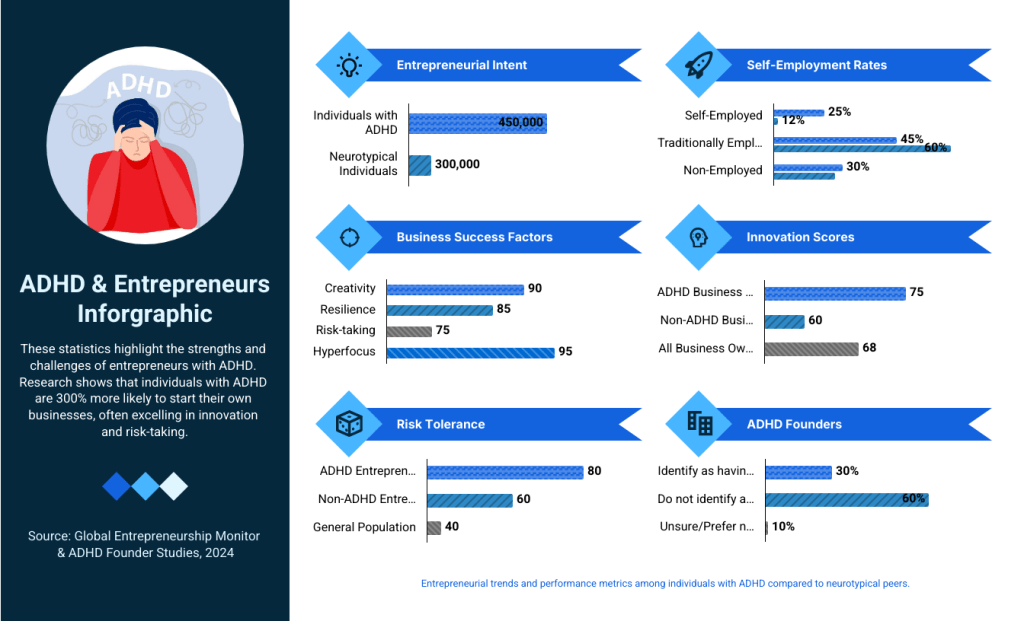
This infographic was built using AI.
The infographic above has six categories. Each category is surveyed by how many people with ADHD have more of an entrepreneurial intent, more self-employment rates, more business success factors, higher innovation scores, and higher risk tolerance. In each category, except from the last, you can see that people with ADHD posses more of these qualities than those who don’t have ADHD.

